


Kakuro Online
How Kakuro works
Kakuro is a crossword made of numbers. Instead of words you fill white cells with the digits 1 to 9, and instead of definitions the black cells carry sums. Every unbroken line of white cells, called a run, must add up to the number shown in the black cell in front of it.
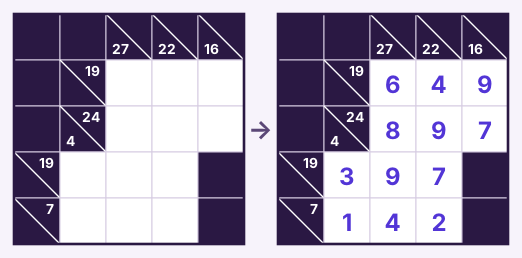
- Each run of white cells has a clue in the black cell just before it. The digits of the run add up to that clue.
- Across clues sit in the top right of a black cell and read along the row to the right. Down clues sit in the bottom left and read down the column.
- A digit cannot repeat inside a run. Only the digits 1 to 9 are used, and a run is 2 to 9 cells long.
- Every puzzle has exactly one solution, and logic alone finds it. You never have to guess.
Tap a white cell and enter a digit with the number pad or the keyboard. Notes let you pencil in candidates. With the combination helper turned on, two lines under the board show the possible sets of digits for the across run and the down run of the selected cell, and cross out the ones that clash with digits already entered. A run that is full but does not add up, or that repeats a digit, is outlined in red as soon as you finish it.
Four levels, from 8×8 to 12×12
| Level | Board | What you need |
|---|---|---|
| Easy | 8×8 | Runs with only one possible set of digits, and cells where an across and a down run force a single digit |
| Medium | 9×9 | Everything above, plus comparing the sets of an across run and a down run, and tracking which digits are still missing from a run |
| Hard | 10×10 | Everything above, plus hidden singles and removing combinations that would leave a crossing run without any possible set |
| Expert | 12×12 | Everything above, plus one-step assumptions: try a digit in a cell, and if some run is left with no possible set, that digit is out |
Boards get bigger as they get harder, so a hard board is not just a medium board with a different number on it. Each puzzle is solved by a program with the techniques of its level before it is published, and puzzles that need more than that are thrown away.
Sums with only one answer
Many Kakuro clues can be made in just one way. Two cells that add up to 4 must be 1 and 3. Three cells that add up to 23 must be 6, 8 and 9. Recognise these and a run is solved as a set before you have placed a single digit; only the order inside the run is left to the crossings.
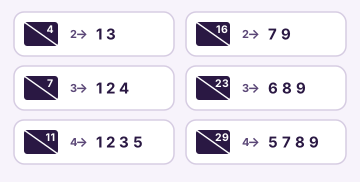
The extremes are the easiest to remember: the smallest and the largest sum of each length have a single set. Two cells make 3 or 17, three cells make 6 or 24, four cells make 10 or 30. The combinations calculator, linked under the board, lists every case from 2 to 9 cells and doubles as a cheat sheet while you play.
Solving step by step
1. Start with runs that have one set
Write the digits of every one-set run into its cells as candidates. Wherever such a run crosses another one-set run, the digit they share is placed at once.
2. Use the crossings
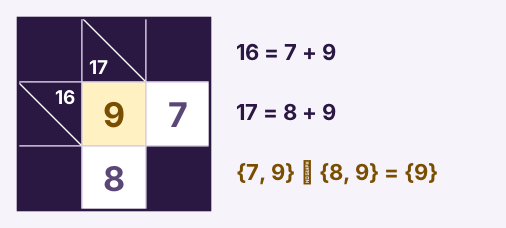
Every white cell belongs to one across run and one down run, so it must satisfy both. Take the possible digits of each run and keep only the digits that appear in both lists.
3. Count what is left in a run
As digits go in, the rest of a run shrinks. Subtract the digits you have placed from the clue and ask which sets remain for the empty cells. A run of three cells worth 20 with a 9 already in it is two cells worth 11, which can be 2 and 9 only if the 9 repeats, so it has to be 3 and 8, 4 and 7 or 5 and 6.
4. Remove combinations that break a crossing run
A set is impossible if placing it would leave a crossing run with no valid set at all. Delete the digits only that set could supply, and singles often appear.
5. Try a digit (expert boards)
On the biggest boards, pick a cell with two candidates and imagine one of them. Follow the consequences through the runs it touches. If a run ends up with no possible set, that digit is wrong, so the other one goes in. This is a one-step check, not a long chain of guesses.
Tips for faster solving
- Scan the long runs and the very small or very large sums first; they have the fewest sets.
- Do not fill notes everywhere. Note only cells where a run has two or three possible digits.
- Use the hint when you are stuck: it fills a cell and names the technique that finds it.
- On a phone, big boards open zoomed in so the cells stay easy to tap; you can switch the zoom in the more menu.
FAQ
- Is this Kakuro free?
- Yes. All four levels are free and unlimited, with no account and nothing to install. Your progress stays on your device.
- What does Kakuro mean?
- It is the common name for the cross-sums puzzle, the number crossword. Many publishers use it as a plain genre name.
- Do I ever need to guess?
- No. Each puzzle is solved by a program using only the techniques of its level, and puzzles that need anything stronger are discarded.
- Can a digit repeat in a run?
- No. Inside one run all digits are different. The same digit can appear in different runs; a cell just has to fit both its across run and its down run.
- Can a cell be 0?
- No. Only the digits 1 to 9 are used, so a run of n cells has a smallest sum of 1+2+…+n.
- Where do I look up which digits make a given sum?
- Open the combinations calculator from the link under the board. It shows every set for runs of 2 to 9 cells and can filter by digits you need or want to exclude.